
Advocates for the park — primarily wealthy merchants and landowners — admired the public grounds of London and Paris and argued that New York needed something comparable. What they got was 843 acres of engineered landscape that took sixteen years to build, and looks like it was always here.
Two questions. We'll point you at the story and where to stand for it.
The design competition
Acres, then and now
To build it by hand
Bridges, no two alike
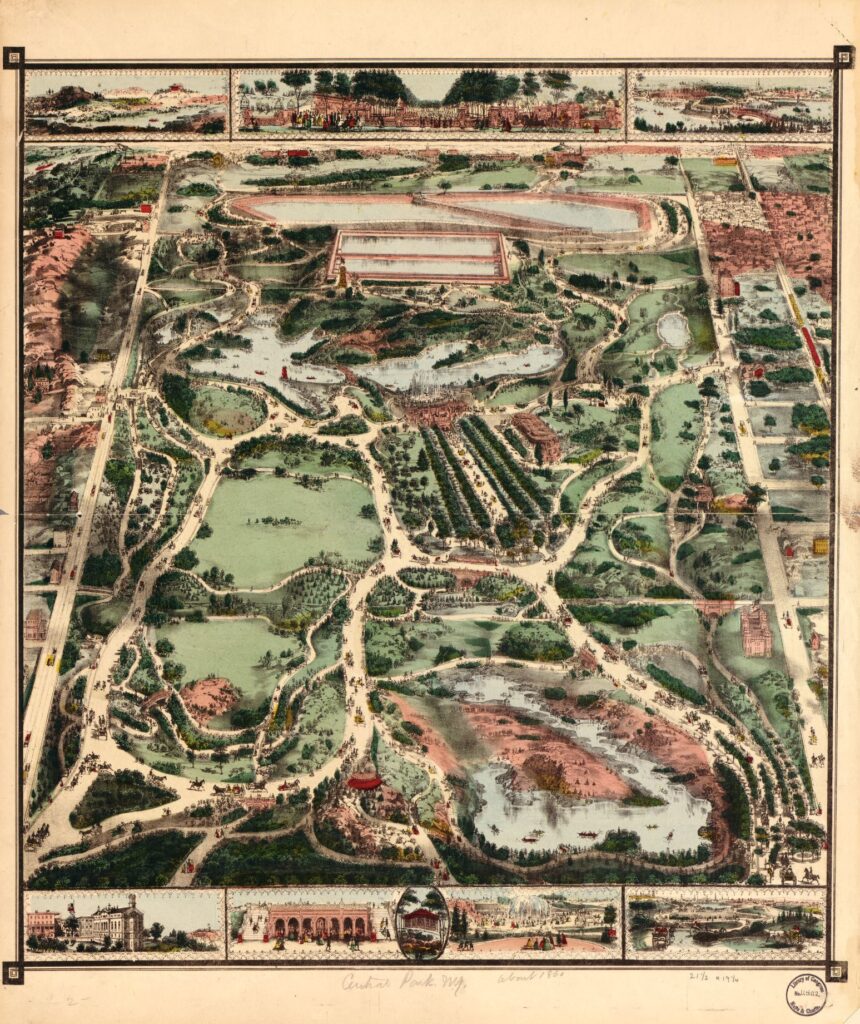
Central Park was the first landscaped public park in the United States. Wealthy merchants and landowners who had seen the public grounds of London and Paris pressed the case that a city of New York’s ambition needed a comparable facility — and in 1853 the state set the land aside.
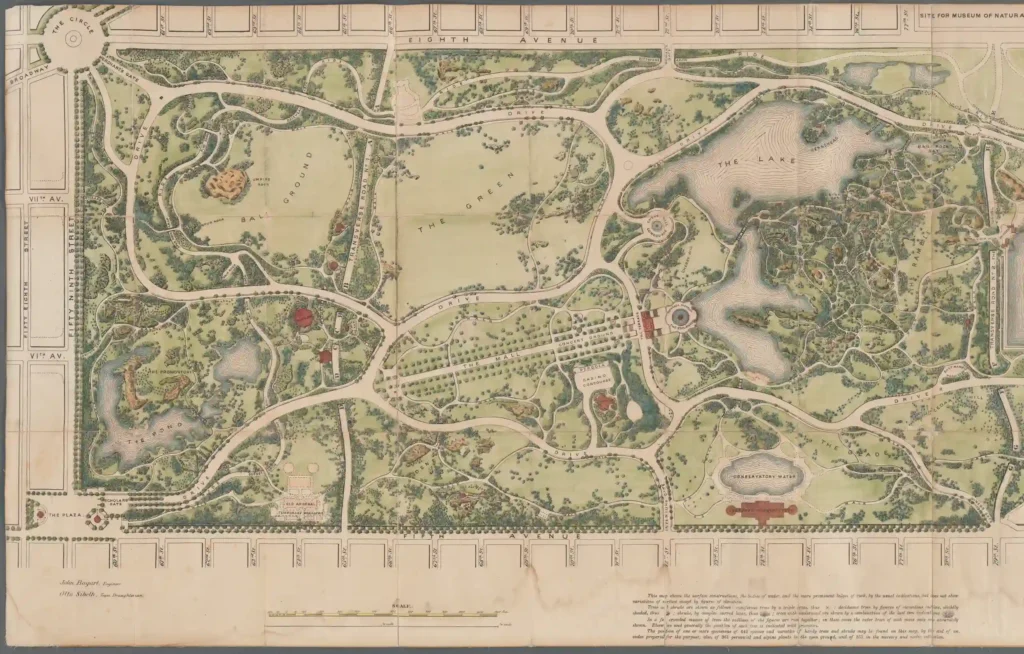
In 1857 the Central Park Commission held the country’s first landscape design contest. The winning entry, submitted by Frederick Law Olmsted and Calvert Vaux, was called the Greensward Plan — and almost every path you walk today follows it.
Calvert Vaux was an architect and landscape designer; Frederick Law Olmsted a landscape designer and administrator. Neither would have built this alone, and the partnership defined American landscape architecture for a century afterwards.
A campaign, a competition and sixteen years of construction. None of what you walk through today was here in 1856.
From the first campaign to the restoration that saved it. Filter by era, or read the whole thing in order.
Nothing about Central Park is accidental. Every hill, path and view was argued over, drawn and then built by hand — and four decisions shaped all of it.
Rather than appointing a designer, the Central Park Commission ran the country’s first landscape design contest in 1857. Thirty-three entries were submitted. The Greensward Plan by Olmsted and Vaux won, and its authors then spent sixteen years defending it.

The site was swamp, rocky outcrop and poor drainage rather than open parkland. Millions of cubic yards of stone and earth were shifted, bedrock was blasted, and topsoil was carted in from New Jersey to grow anything at all.

The plan’s cleverest idea: four crosstown roads sunk below the sightlines of the park, so commercial traffic could cross the island without ever appearing in the landscape. Visitors still walk over them without noticing.

Millions of trees, shrubs and plants went in to create scenery that reads as natural. The Ramble was deliberately laid out to disorient you; the Mall was built dead straight so it wouldn’t. Both are entirely artificial.

The architectural heart of the Greensward Plan, and the only formal structure in it.
The park you walk through today is the third version of itself. Understanding which era you are looking at explains most of what you see.
Competition, plan and sixteen years of construction. Almost every path, bridge, terrace and water body you see today was set out in this period.
Funding fell away, planting was lost and recreation was built over landscape. By the 1970s much of the park was eroded and widely thought unsafe after dark.
The Central Park Conservancy was founded in 1980 and has rebuilt the park piece by piece. Bethesda Terrace, the Ramble, the Great Lawn and the Harlem Meer were all restored.
The land was set aside in 1853, the design competition ran in 1857, construction began in 1858 and the park was substantially complete by 1873 — about sixteen years of building, almost all of it done by hand.
Frederick Law Olmsted and Calvert Vaux, jointly. Vaux was an architect and landscape designer, Olmsted a landscape designer and administrator who went on to oversee the construction. Their entry, the Greensward Plan, won the 1857 competition.
The winning entry in the country’s first landscape design contest, held by the Central Park Commission in 1857. It set out the paths, the water, the planting and the sunken transverse roads — and the park still follows it closely today.
It was the first landscaped public park in the United States — the first designed from scratch as a work of landscape architecture rather than adapted from existing common land. That distinction is what made it so influential.
Swamp, rocky outcrop, small farms and several settled communities. The best documented is Seneca Village, a community of roughly 225 residents, many of them Black landowners, established in 1825 and cleared in 1857 so construction could begin.
Very little. The ground was reshaped, bedrock was blasted, topsoil was brought in and millions of plants were put in the ground. The Ramble was designed to feel wild and the Mall was designed to feel formal — both are entirely constructed.
It was the Greensward Plan’s cleverest idea. Four transverse roads were built below the level of the park so commercial traffic could cross Manhattan without appearing in the landscape at all. You walk over them without noticing.
The Central Park Conservancy, a private non-profit founded in 1980 in partnership with the city, after decades of decline. Most of what visitors admire today — Bethesda Terrace, the Great Lawn, the Ramble — has been restored since then.
Our guided walking tours cover the Greensward Plan, Bethesda Terrace, the Ramble and the story of Seneca Village — told where it happened rather than read off a page.